Scrap Week Ahead: Factory Output
Market notes · Published
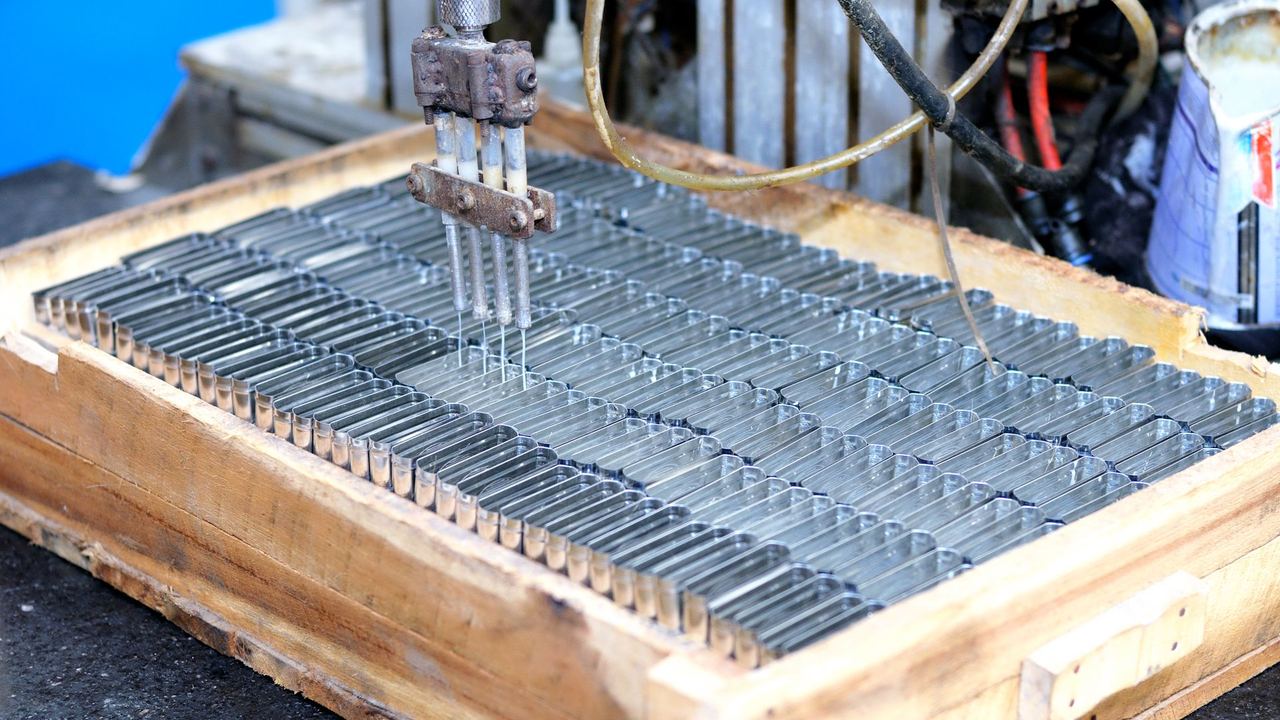
Industrial scrap leads the scrap week ahead for November 16 to 20, 2026. On Tuesday the Federal Reserve reports how much America's factories made in October, and factory output is where industrial scrap comes from: offcuts, turnings and rejected parts from every shift. This issue also covers Tuesday's retail sales, with appliance stores in them, and Wednesday's yearly report on workplace injuries. Every date and figure names its source, and nothing here is a forecast of your yard's board.
The week in four lines
Four dated releases matter this week, and the card below puts them on one page.
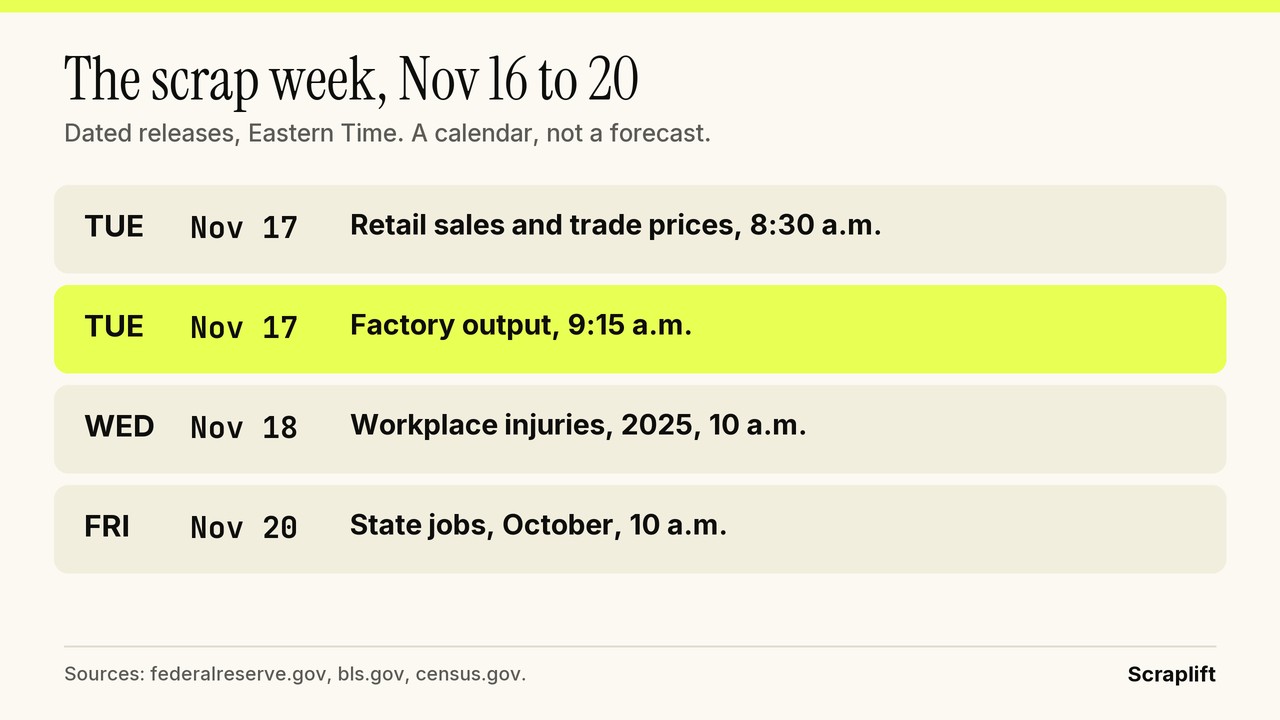
Here is the same week in words, with times in Eastern Time as each source lists them:
- Tuesday, November 17: retail sales for October and import and export prices, both at 8:30 a.m.
- Tuesday, November 17: factory output for October from the Federal Reserve at 9:15 a.m.
- Wednesday, November 18: the yearly report on workplace injuries and illnesses for 2025 at 10:00 a.m.
- Friday, November 20: state jobs numbers for October at 10:00 a.m.
Get the app
Free.
Tuesday: factory output and industrial scrap
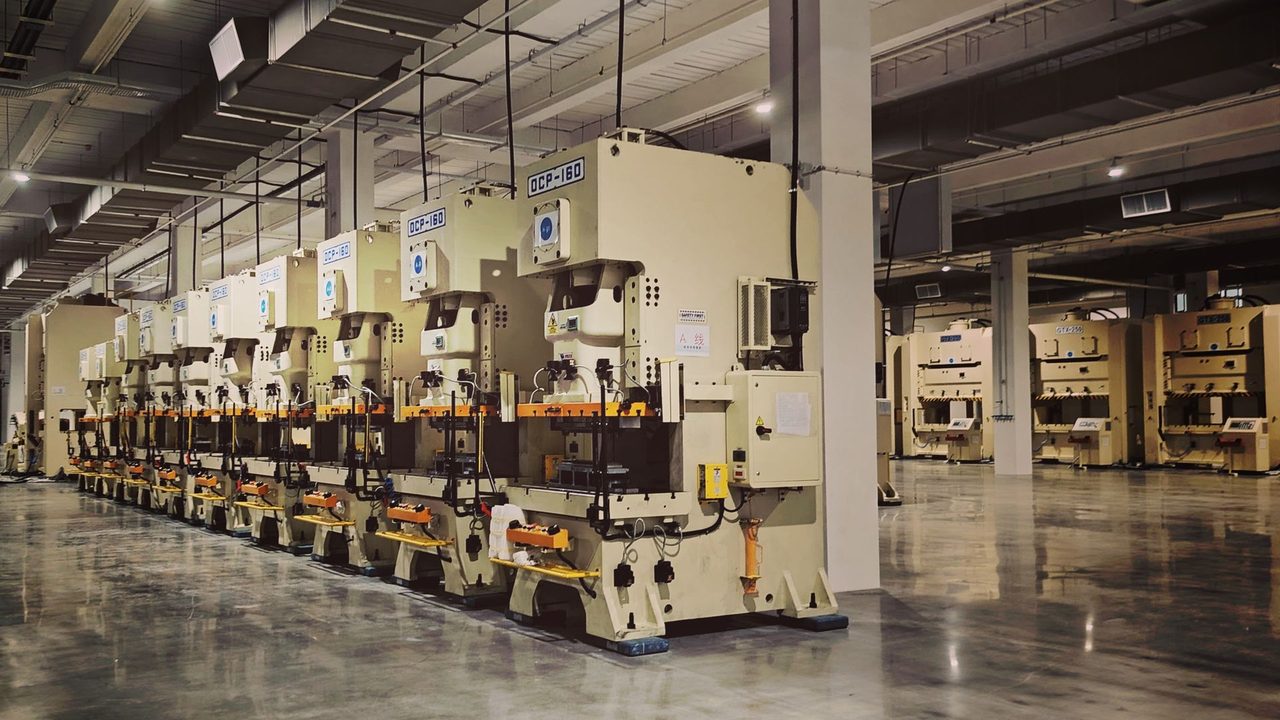
The Federal Reserve publishes its industrial production report on Tuesday, November 17, at 9:15 a.m., per its release schedule. It measures how much the country's factories, mines and utilities turned out in October. For a hauler, the factory part is the one to watch, because factory output is where industrial scrap comes from.
Look at September for a sense of where things stand. The September report, released October 16, said industrial production rose 0.7 percent in the month and manufacturing output rose 0.3 percent. Total output stood 2.2 percent above a year earlier, and manufacturing was up 1.1 percent over the same 12 months.
Which factories were busy in September
The same report named primary metals, machinery, and electrical equipment, appliances and components among the durable goods lines that gained 1 percent or more in September. Output of motor vehicles and parts fell 3.0 percent.
Capacity utilization, the share of capacity in use, moved up to 76.9 percent for all industry and 75.9 percent for manufacturing. Our reading: a plant running closer to full makes more parts, and every part leaves some industrial scrap behind. That is a direction for the season, not a price for your next haul.
What industrial scrap is

Industrial scrap is the metal a plant throws off while it makes something else. It is also called prompt scrap or new scrap, and it differs from old scrap, which comes out of things people used and threw away. A stamping plant makes skeletons and blanks. A machine shop makes turnings and chips. A fabrication shop makes drops, cut ends and short lengths.
Because it is new metal of a known alloy, industrial scrap is often clean and easy to grade. A bucket of brass turnings from one job is brass turnings, not a mystery. That makes it worth more per pound than the same metal mixed into a cleanout, and it keeps coming every week the plant runs.
Scrap tip: Keep machine shop turnings apart from solid offcuts, and keep each alloy in its own drum. Many yards price turnings differently from solids, and some take them only drained of oil and coolant, so ask how your yard takes them before you haul.
Where a small hauler fits
Big plants sell their industrial scrap by contract, often to a yard that drops a container on site. A one person hauler rarely wins that. The opening is the small end: the two person machine shop, the sign maker, the welding shop, the cabinet and countertop shop with aluminum trim, the HVAC contractor with a back lot of copper and steel drops.
Those shops make industrial scrap every week, but not enough to justify a roll off. A pickup on a set day can be the easiest answer for them. Ask what they throw out, how much in a month, and which day suits them, then show up on that day every time.
How to read Tuesday's numbers
Look at the change from the month before and at manufacturing, not the headline alone. Utilities can swing the total on weather, and that tells you nothing about industrial scrap. If manufacturing rises again, factories made more in October. If it falls, they made less. Either way, it says what happened last month, and your yard's board may already reflect it.
Related reading: Last week we followed the scrap that comes out of houses a room at a time. Our scrap week ahead for November 9 to 13 covers remodeling scrap, the household side of the same steady, small job work.
Tuesday: retail sales and the appliances that come out
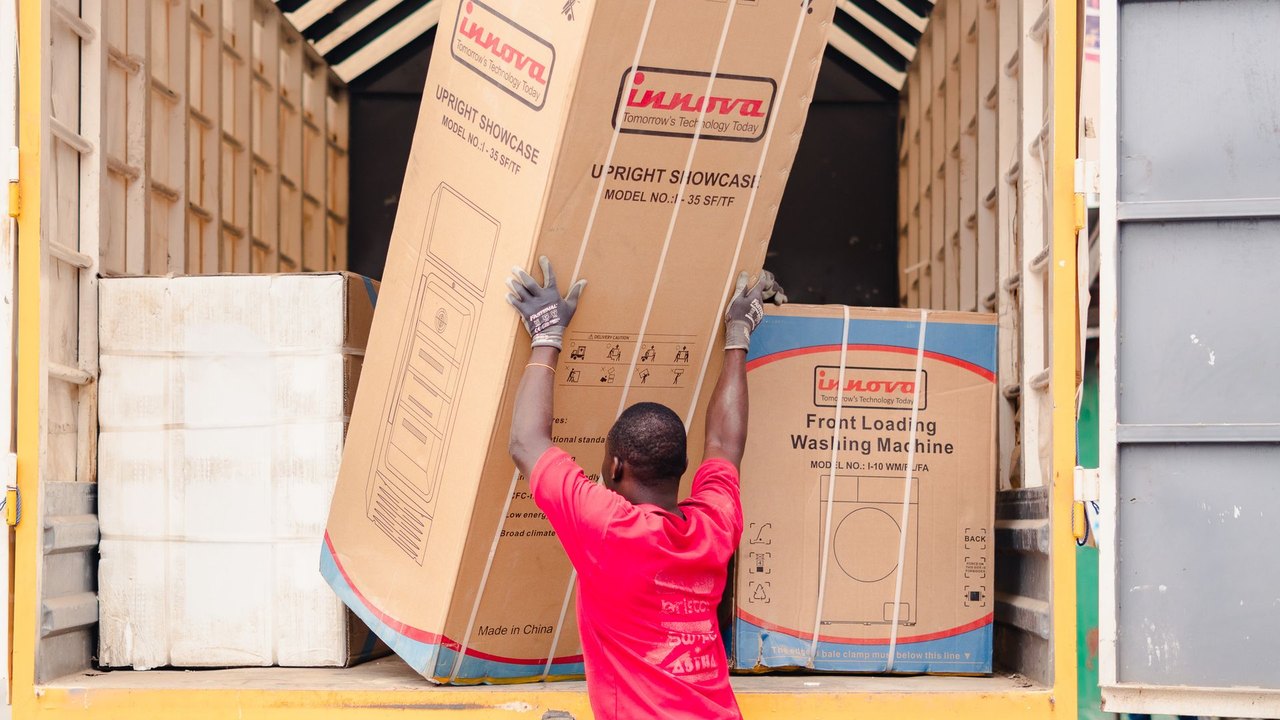
The Census Bureau releases retail sales for October on Tuesday, November 17, at 8:30 a.m., per its economic calendar. The number counts what stores sold, from cars to groceries. One line in it matters more to a hauler than the rest: sales at electronics and appliance stores.
In the September report, released October 15, total retail and food services sales were $745.0 billion, up 0.8 percent from August and 6.3 percent from September 2025. Sales at electronics and appliance stores rose 0.6 percent from August and 9.4 percent from a year earlier. Those figures are seasonally adjusted but not adjusted for price changes, so part of the rise is higher prices, not more units.
Why new appliances mean old ones
A new washer, range or fridge in a house almost always means an old one coming out. Some stores haul the old unit away, and some homeowners keep it in the garage or the basement until someone takes it. That old unit is mostly steel, with copper in the motor and the wiring, and sometimes aluminum.
Our reading: a strong year at appliance stores points to more old units in garages and basements over the winter. It is not a promise of any number, and it says nothing about what your yard pays for appliances this week. It does say where to look.
Scrap tip: Leave your number with appliance installers, small repair shops and delivery crews. They pull old units every day and often want them gone fast. Ask your yard first how it takes refrigerators and air conditioners, since units with refrigerant usually need it recovered before a yard accepts them.
What else is in Tuesday's report
The same Census report breaks out building materials stores, car dealers and general stores. A hauler can read it as a rough map of where money is going. Our reading: strong building materials sales line up with renovation work, and strong car sales mean more trade ins somewhere down the line. The figures are national and monthly, so read them for direction, not for a price.
Wednesday: the yearly injury report, and scrap work is not light work

On Wednesday, November 18, at 10:00 a.m., the Bureau of Labor Statistics releases its yearly report on employer reported workplace injuries and illnesses for 2025, per its release schedule. It counts injuries and illnesses by industry, per 100 full time workers.
The most recent full year, 2024, shows where scrap work stands. In the BLS industry table for 2024, all private industry recorded 2.3 injuries and illnesses per 100 full time workers. Recyclable material merchant wholesalers, the federal name for scrap yards and dealers, recorded 3.7. Waste collection recorded 4.7, and materials recovery facilities recorded 5.9.
Scrap yards against other work
The card below puts those four rates side by side.
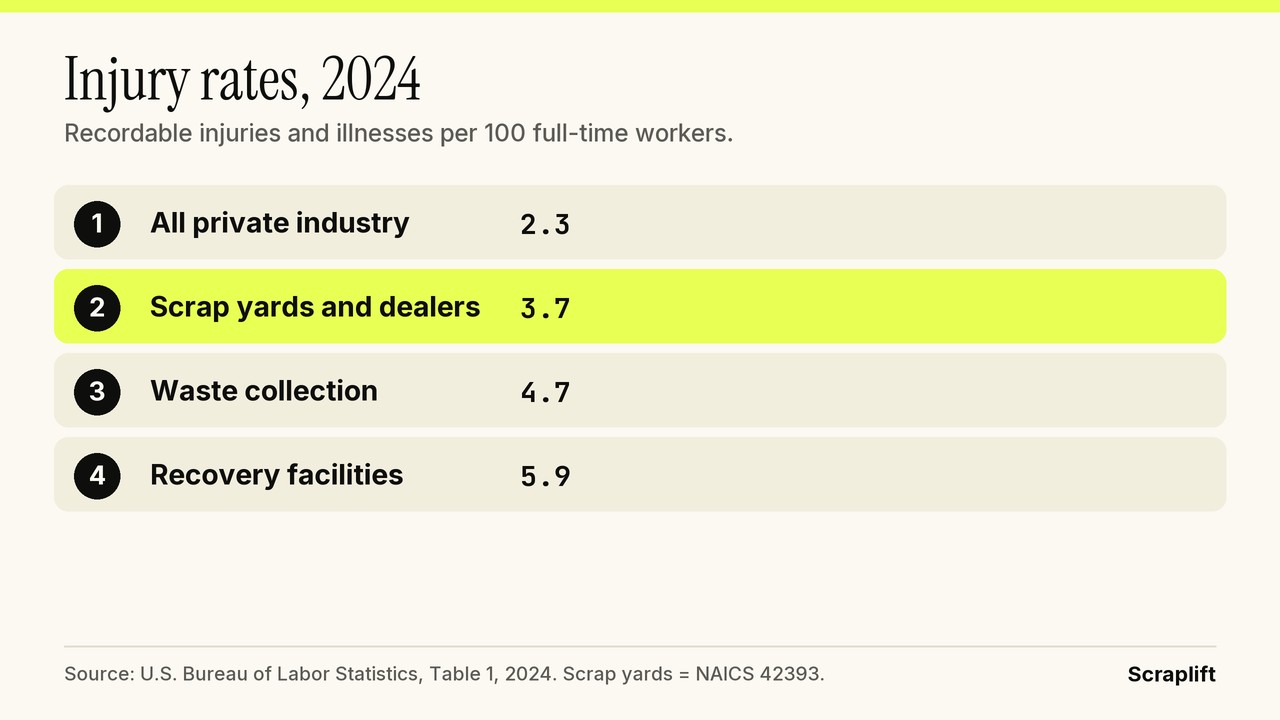
Scrap yards and dealers ran about 60 percent above the private industry rate. For the scrap yard group, 2.1 cases per 100 workers were serious enough to mean days away from work, a job transfer or restricted duty, against 1.4 for all private industry.
These counts cover employees at businesses, not a one person hauler working alone. A solo hauler is not in the table at all. That does not make the work safer. It means nobody counts the cut hand or the bad back except the person who has it, and a week off the truck is a week without pay.
What Wednesday's numbers will add
Wednesday's report covers 2025. Compare the scrap yard line with 2024's 3.7 and with the private industry rate. A rise or a fall in one year is not a trend, but the gap was there the year before too: in the 2023 table, scrap yards and dealers recorded 4.7 against 2.4 for all private industry. Read it as a reminder, not a headline.
Scrap tip: Wear cut resistant gloves and safety glasses on every pickup, not only the heavy ones. Sharp edges and heavy weight come with every haul. Lift with your legs, use a dolly or a ramp for appliances, and never ride metal loose in an open bed.
What it means for your week
Tuesday tells you whether factories made more in October, which is where industrial scrap comes from. It also tells you how much people spent at appliance stores, which is where old appliances come from. Wednesday tells you how hard scrap work is on the body, and the 2024 answer was not easy.
None of these numbers sets your price. Your yard's posted board does that, for your grade and your day. The numbers point to where the steady metal is this winter: small shops with industrial scrap every week, and houses with an old appliance waiting in the garage.
On fuel, the U.S. diesel average was $6.127 a gallon for the week of November 9, down 16.5 cents, per the EIA. The next update is Tuesday. Thanksgiving falls the week after, on November 26, so call your yard about its holiday hours before you plan that week's runs.
Related reading: Copper fell to a four month low on the London exchange last week. Our scrap week recap for November 9 to 13 explains why that exchange price is not your yard's number, and how to sort copper when the market swings.
Between issues, the scrap rates page shows posted prices by ZIP code, the New York yard directory lists yards across the state, and Scraplift ranks the yards near you by what you clear after the drive.
This is general market commentary, not financial advice and not a promise. Your yard's own posted price for your grade is what you are paid. Check the date and the grade on any quote before you agree to it.
Quick answers
What is industrial scrap?
Industrial scrap is the metal a factory throws off while making something else, such as offcuts, turnings, stampings and rejected parts. It is also called prompt or new scrap.
When is the October industrial production report released?
On Tuesday, November 17, 2026, at 9:15 a.m. Eastern, per the Federal Reserve's release schedule.
How much did industrial production rise in September 2026?
Industrial production rose 0.7 percent in September and manufacturing output rose 0.3 percent, per the Federal Reserve's report of October 16.
How did appliance store sales do in September 2026?
Sales at electronics and appliance stores rose 0.6 percent from August and 9.4 percent from a year earlier, per the Census Bureau's report of October 15.
Is scrap yard work more dangerous than other jobs?
In 2024, scrap yards and dealers recorded 3.7 injuries and illnesses per 100 full time workers, against 2.3 for all private industry, per the Bureau of Labor Statistics. </content> </invoke>