Scrap Week Recap: Fuel Squeeze
Market notes · Published
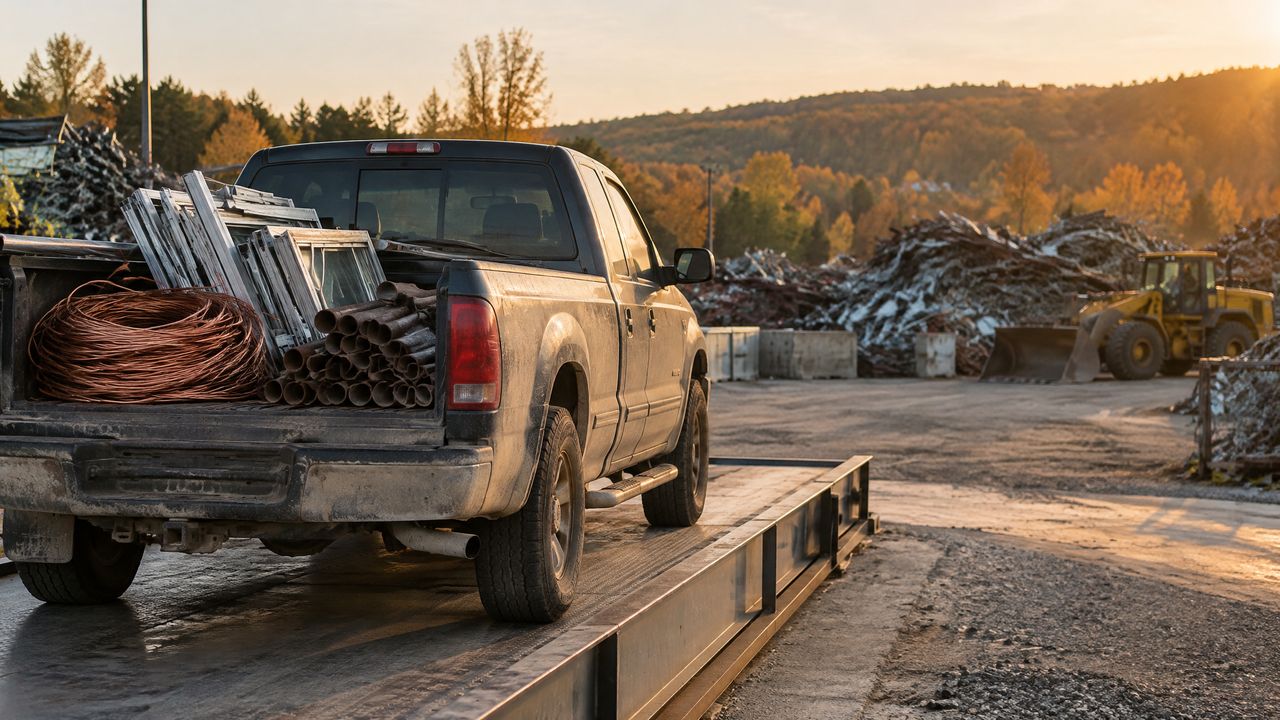
This is the scrap week recap for October 12 to 16, 2026: what the fuel numbers, the scrap price indexes and the week's news said, and what each one means for a hauler. Every figure in this scrap week recap names its source and its date, and nothing in it is a forecast.
The short version of the scrap week recap is a fuel squeeze. Diesel barely moved on the week but costs about two thirds more than a year ago, diesel prices at the producer level jumped in September, and the official copper scrap index crossed 1,000, the first reading that high since at least 1996, while aluminum slipped.
The scrap week recap in four lines
Here is the scrap week recap at a glance, before the detail:
- Fuel: Central Atlantic diesel was $6.471 a gallon on October 12, down 1.4 cents on the week and up $2.594 on the year (Energy Information Administration).
- Scrap prices: in September the copper-base scrap index rose 0.9 percent, aluminum base scrap fell 3.7 percent and iron and steel scrap slipped 0.3 percent (Bureau of Labor Statistics, preliminary).
- News: the Federal Reserve's New York report says construction held steady and fuel costs kept squeezing margins.
- Tip: know your own fuel cost per mile, because it changed more this year than most grade prices did.
Our Week Ahead issue on Monday flagged Thursday as the day to circle, and it was.
Get the app
Free.
Fuel: flat on the week, up two thirds on the year

The Energy Information Administration's weekly retail diesel prices put the Central Atlantic region, which includes New York, at $6.471 a gallon on October 12, 2026. That is 1.4 cents lower than the week before and $2.594 higher than a year earlier, when the same region read $3.877. Put plainly, diesel costs about 67 percent more than it did last October. New York State gasoline was $4.353, up $1.298 on the year.
What the price indexes added
The Bureau of Labor Statistics filled in the bigger picture. Its consumer price index for September, out Wednesday, showed all prices up 3.7 percent on the year, energy up 20.4 percent, gasoline up 34.2 percent and fuel oil up 74.2 percent.
On Thursday the producer price index for September showed what businesses pay. Final demand prices rose 1.3 percent in the month and 6.3 percent on the year, the largest yearly rise since December 2022. The release says diesel fuel prices rose 21.0 percent in September, and energy drove more than 80 percent of the month's rise in goods prices.
Scrap tip: Write the diesel price on the same line as every price quote you take. A quote from a farther yard only means something next to what the drive costs that week, and the two numbers together tell you which yard actually pays more.
What a mile costs now
Here is an example, not a quote. It is a number worth updating. A truck that gets 12 miles per gallon burns about 54 cents of diesel a mile at $6.471.
A year ago, at $3.877 in the same region, the same mile cost about 32 cents. Your own truck will differ, so use your real miles per gallon.
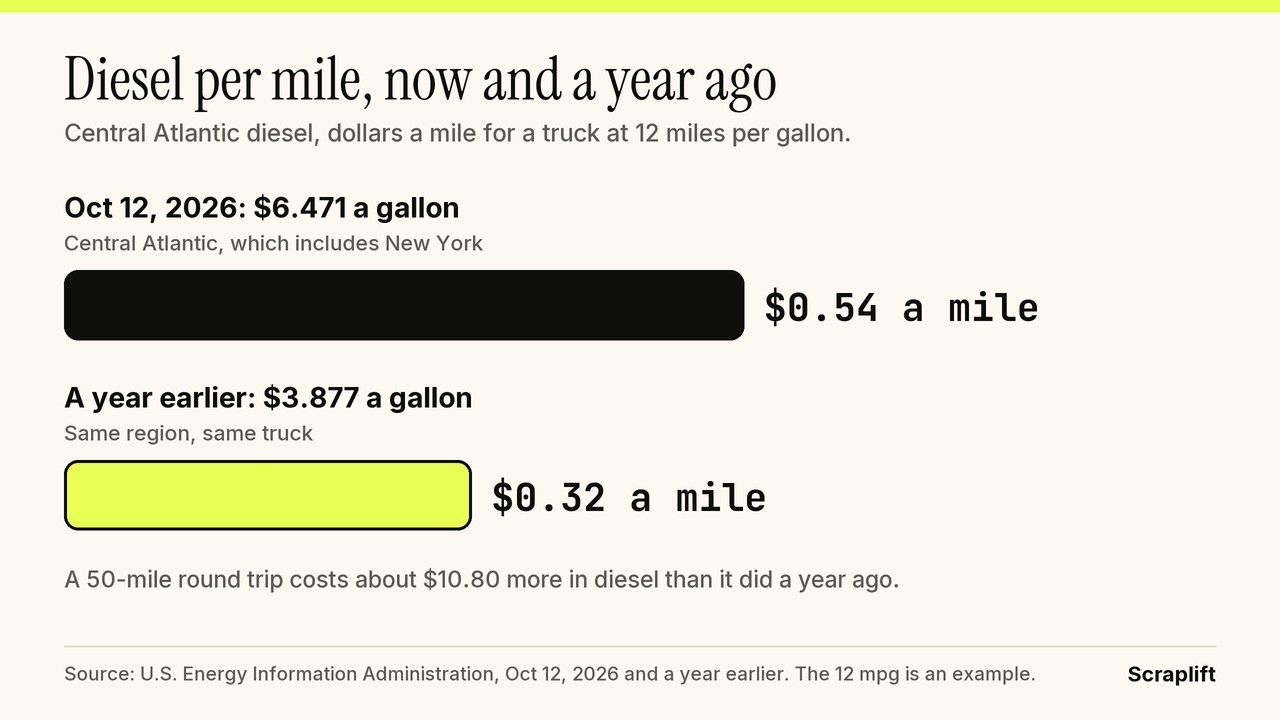
The card shows the gap. On a 50-mile round trip the difference is about $10.80 of diesel, every trip, before the scale reads a single pound.
Over a week of five such trips that is about $54 more in diesel than last October, at the same miles per gallon.
Scrap metal prices: the September indexes
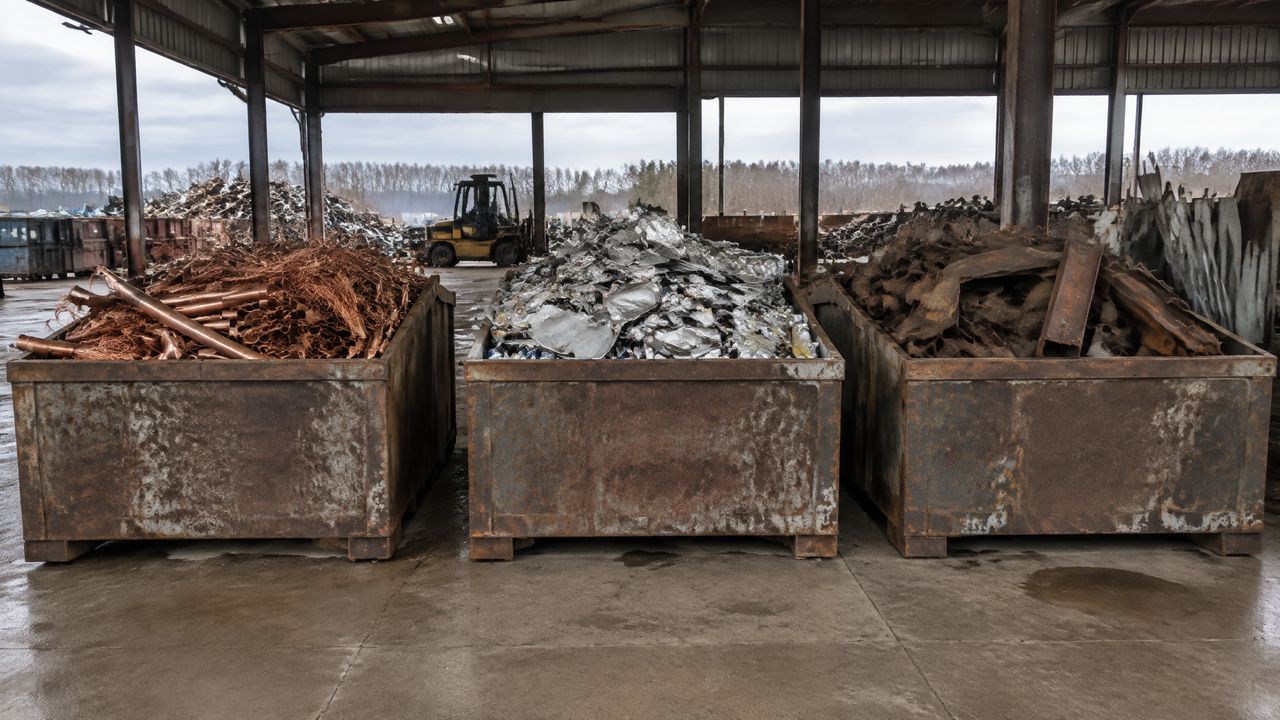
The Bureau of Labor Statistics publishes three scrap series inside the producer price index. They measure what producers are paid, a month or more behind the market, not what a yard posts. Both August and September are marked preliminary and can be revised for up to four months.
What the three indexes said
Copper-base scrap rose to 1,005.862 in September from 996.787 in August, up 0.9 percent, and it is up about 48 percent on September 2025. It is the first reading above 1,000 since at least 1996, as far back as we checked.
Aluminum base scrap fell to 448.098 from 465.526, down 3.7 percent, though it is still up about 23 percent on the year. August itself was revised down, from 475.545 to 465.526.
Iron and steel scrap edged down to 580.952 from 582.967, about 0.3 percent, and it is up about 10 percent on the year.
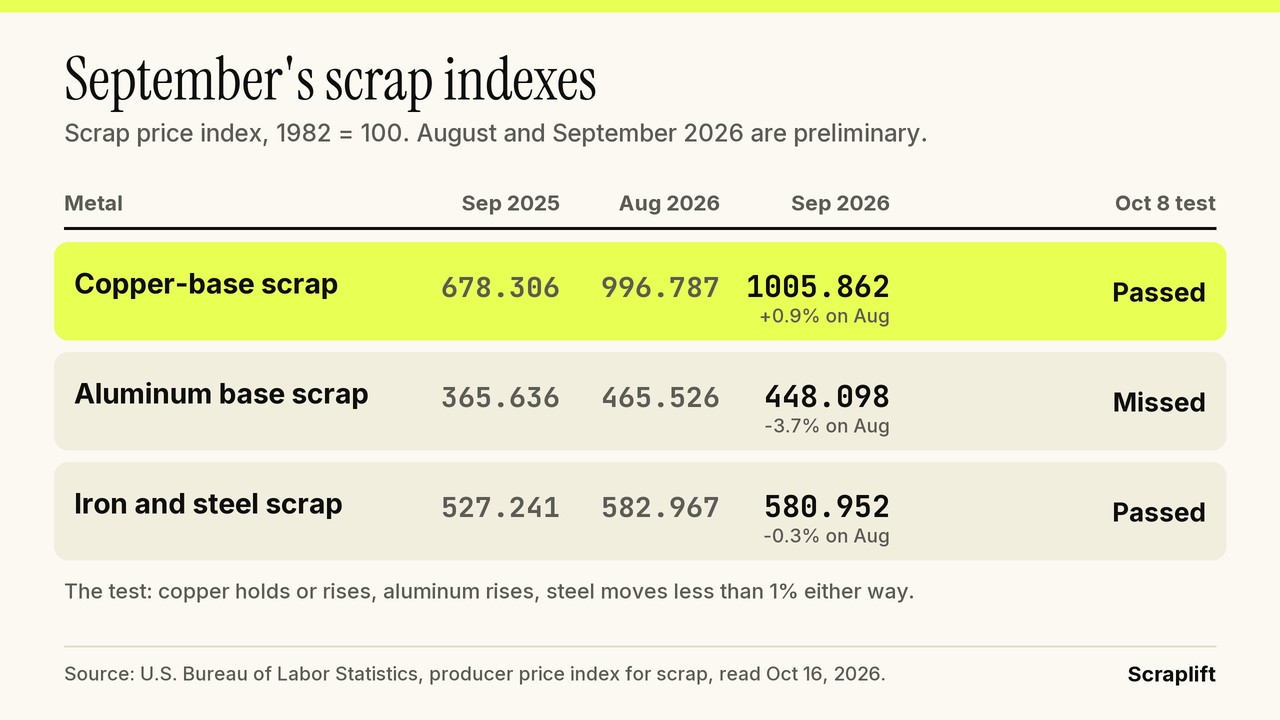
The card puts the three side by side with a year ago, so the yearly gains and the one monthly drop sit on the same page.
How our October 8 reading did
On October 8 our Metals to Watch post read copper as firm, aluminum as mixed leaning firm and steel as mixed, and that post set a test for this index. Our Week Ahead issue repeated it. Copper should hold or rise, aluminum should rise, and steel should move less than 1 percent either way.
Copper and steel passed. Aluminum missed: it fell 3.7 percent instead of rising, and the downward revision to August says the market was softer than the first number showed. We said we would call it if a metal did the opposite, and this scrap week recap is where we do. Our aluminum reading was wrong for September.
Scrap tip: Keep aluminum sorted by type even when the price softens. Cast, extrusion and sheet are separate grades at most yards, and a mixed pile is often paid at the lowest grade in it, so sorting matters more in a soft month, not less.
Steel scrap in October
The index is September. For October, the free headlines at Steel Market Update point up. On October 6 it reported that October scrap prices were seen rising in early trading, citing one Detroit-area buyer that paid $20 a gross ton more for shredded and plate and structural, and $10 more for busheling. On October 9 its headline said US scrap prices had strengthened from those initial levels, with the market only partly settled.
Keep the two apart. Mill trades are not the yard price on your grade. They say steel scrap demand at the mills did not weaken in October.
Related reading: The index and the mill trades move on different clocks, and the gap trips people up. Why steel prices can rise while scrap steel does not explains how mill steel and scrap steel come apart, which is the right lens for reading October's trades.
The week's news and what it means for haulers

Two reports this week spoke directly to where scrap comes from and what it costs to move.
The Fed on New York: steady building, costly fuel
The Federal Reserve's Beige Book for the New York district, released October 14, said activity increased slightly, led by manufacturing. It said construction held steady after several months of strong growth, and that energy and fuel costs remained a drag on profit margins, particularly for transportation and other fuel-intensive businesses.
Building held up, so the demolition and renovation work that fills a truck with steel, copper and ductwork is still there. Fuel is what squeezes the margin on each trip, which is the same story the price indexes told.
Scrap tip: Ask a demolition or renovation crew what metal comes out of the job before you quote the haul. Ductwork, steel studs and copper offcuts go to different piles, and knowing the mix up front tells you whether one yard trip covers the fuel.
Import and export prices
On Friday the Bureau of Labor Statistics published import and export prices for September. Import prices rose 1.1 percent in the month, and fuel import prices were up 34.5 percent on the year. On the export side, the release says lower prices for nonferrous and other metals partly offset higher prices for industrial supplies in September.
The release does not publish a scrap grade, so we read it as background. Our reading, not the report's: softer export prices for nonferrous metals fit with the drop in the aluminum scrap index, and both are worth watching for October.
This week's tip: know your cost per mile

Each scrap week recap ends on one tip, and this one is about the number that changed most for a hauler this year. It is not a grade price. It is fuel cost per mile, and it is worth checking that yours is not last year's.
Here is how to work out your own in a minute. Take the diesel price from the EIA weekly page and divide it by your truck's real miles per gallon with a full bed, not the sticker figure. At $6.471 and 12 miles per gallon that is about 54 cents a mile.
Then use it on the next choice between two yards. Multiply the extra round-trip miles by your cost per mile, and compare that to the extra the farther yard pays for your pile. Our post on when the farther yard still pays walks through the full math with a worked example.
Update the number every Tuesday when the new diesel price comes out. Last fall's figure is about 22 cents a mile too low at 12 miles per gallon.
Related reading: A quote is only as good as what you write down with it. The five lines worth keeping on every quote shows a simple way to log grade, date, weight and price, so your cost per mile has something to sit next to.
What we watch next week
Tuesday, October 20 brings the next diesel update from the Energy Information Administration. The Recycled Materials Association holds its Fall Meeting from October 20 to 22, per its events page. The Federal Reserve meets October 27 and 28, and the October producer price index, with the next scrap readings, comes on November 13. Next Friday's scrap week recap reads the October 20 diesel number against this one.
Between one scrap week recap and the next, the scrap rates page shows posted prices by ZIP code, and Scraplift ranks the yards near you after fuel costs, so the diesel number is already counted.
This is general market commentary, not financial advice and not a promise. Your yard's own posted price for your grade is what you are paid. Check the date and the grade on any quote before you agree to it.
Quick answers
What happened in the scrap week recap for October 12 to 16?
The scrap week recap for October 12 to 16 found diesel flat on the week at $6.471 a gallon in the Central Atlantic region on October 12, 2026, up $2.594 on the year. The September scrap indexes showed copper up 0.9 percent, aluminum down 3.7 percent and steel down 0.3 percent.
How much did diesel go up in a year?
The Energy Information Administration put Central Atlantic diesel at $6.471 a gallon on October 12, 2026, against $3.877 a year earlier, about 67 percent more.
What did the September copper scrap index show?
The Bureau of Labor Statistics copper-base scrap index rose to 1,005.862 in September 2026 from 996.787 in August, up 0.9 percent. Both months are preliminary.
Why did the aluminum scrap index fall?
The Bureau of Labor Statistics does not give a reason in its index. It shows aluminum base scrap down 3.7 percent in September 2026, and the import and export release says export prices for nonferrous metals were lower that month, which in our reading fits the drop.
How do I work out my diesel cost per mile?
Divide the diesel price by your truck's real miles per gallon. At $6.471 a gallon and 12 miles per gallon, that is about 54 cents a mile.