Scrap Week Ahead: Building Season
Market notes · Published

This is the scrap calendar for October 19 to 23, 2026: the days when new numbers on building and the scrap trade arrive, and what each one means for a hauler. It is a calendar and not a forecast, so every line names its source and its date.
The lead this week is building. On Tuesday the Census Bureau reports how many homes were started and permitted in September, which is an early read on how much pipe, wire, steel and tear-out metal the trades will be throwing off this winter. The same morning the recyclers' trade group opens its three-day fall meeting.
The scrap calendar at a glance
Four dated days make up the week, and the card below puts them on one page.
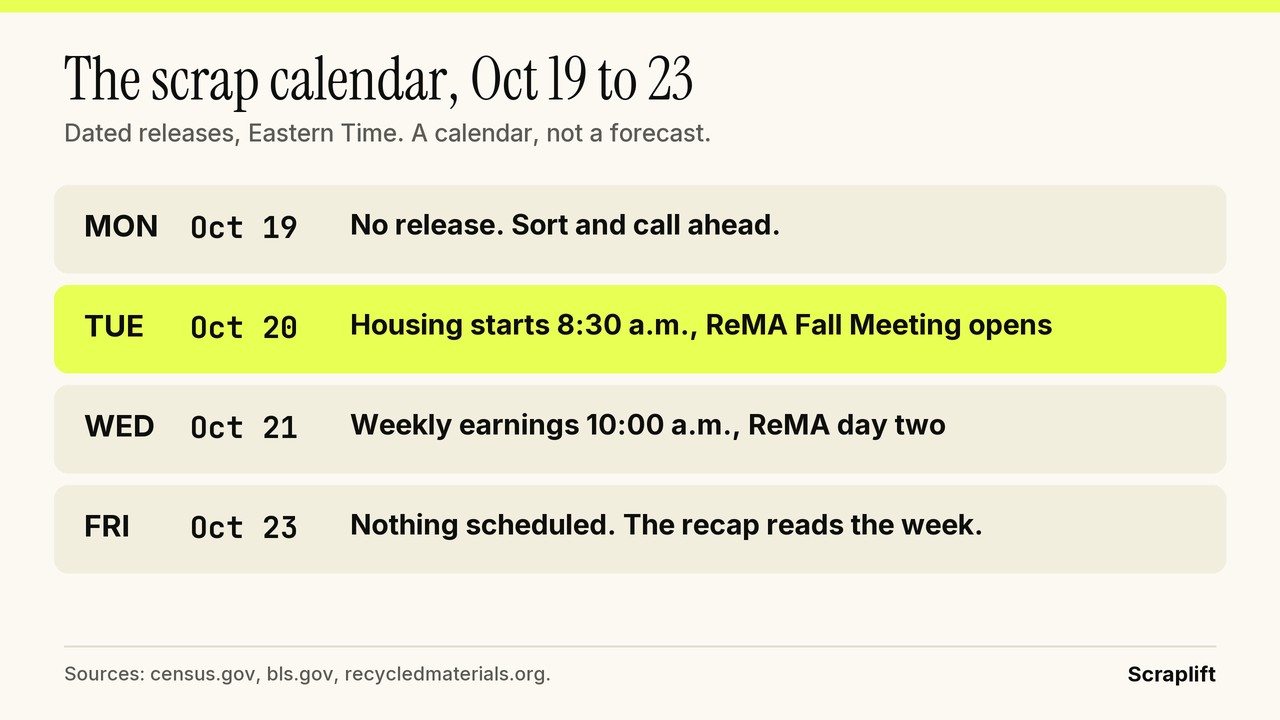
The card shows the scrap calendar in four lines. Tuesday is the day to circle on the scrap calendar, because the building numbers and the industry meeting start within a few hours of each other.
Here is the same week in words, with the times in Eastern Time as each agency lists them:
- Monday, October 19: no Bureau of Labor Statistics release and no federal holiday.
- Tuesday, October 20: the Census Bureau's September housing starts and building permits at 8:30 a.m., state employment numbers at 10:00 a.m., and the first day of the Recycled Materials Association's Fall Meeting. The weekly diesel update also lands that day.
- Wednesday, October 21: usual weekly earnings for the third quarter at 10:00 a.m., and the second day of the fall meeting.
- Thursday, October 22: the last day of the fall meeting.
- Friday, October 23: nothing scheduled by the agencies we follow.
Nothing on the scrap calendar sets the price your yard pays. A yard posts its own price for each grade. The list tells you which day new facts arrive.
Get the app
Free.
Monday, October 19: a quiet start
Monday opens the scrap calendar without a release. The Bureau of Labor Statistics October schedule has nothing on October 19, and this is not a holiday week, so every agency keeps its normal days.
That makes Monday a good day for the plain work: sorting what is already on the truck and calling the yards you sell to. Our scrap week recap has last week's numbers if you want them next to this week's. Last week's Week Ahead issue shows how the same calendar looked a week earlier.
Scrap tip: Use the quiet Monday to call ahead. Ask the yard for its posted price on your two biggest grades, write down the time and the name of whoever answered, and you have a dated quote to check against the board when you arrive.
Tuesday, October 20: housing starts and building permits
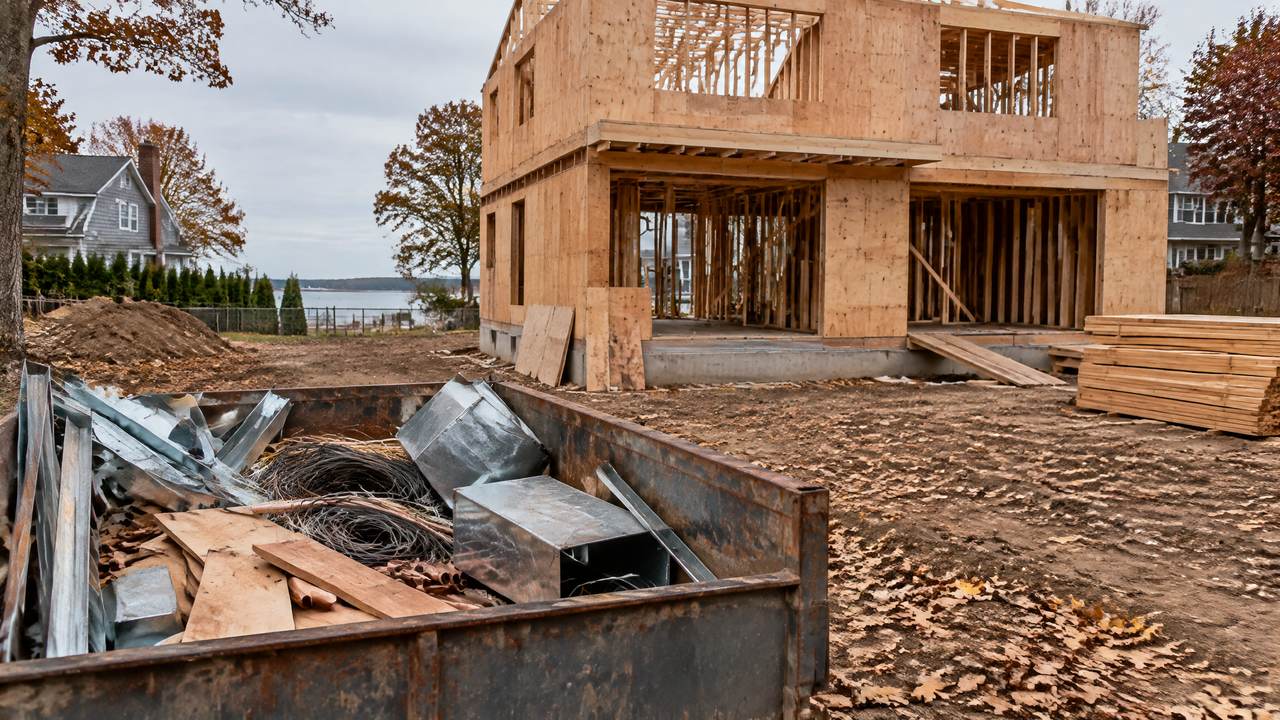
At 8:30 a.m. the Census Bureau publishes New Residential Construction for September, per its economic indicator calendar. The report has three numbers. Building permits are filed before work starts. Housing starts count new homes where digging for the foundation began that month. Completions count homes finished that month.
Why a hauler might read it
A lot of scrap starts on a building site. New construction throws off copper pipe offcuts, wire ends, steel studs, ductwork and aluminum trim. Permits come first, so a rise in permits points to more sites a few months out, and a fall points to fewer.
The report also gives regional numbers, per the Census Bureau's construction page, and the Northeast is the region closest to New York and Long Island. A national number can rise while the Northeast falls, so read the region before you read anything into the headline.
We will be plain about how far it reaches. It is a monthly number, a month behind, about new homes only, and it does not tell you what any yard pays. Read it as background on how busy the trades will be, not as a price signal.
Renovation is the other half
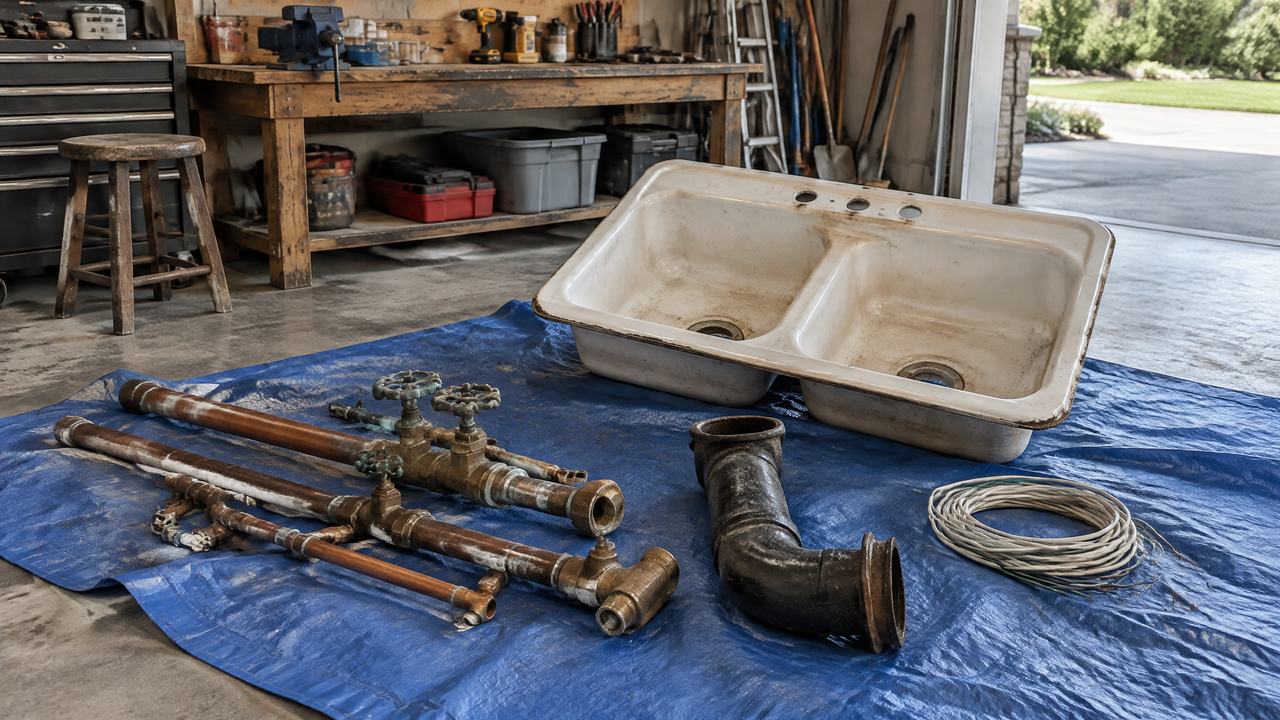
New homes are only part of the building story. Remodels and tear-outs produce some of the best-paying scrap a hauler sees: old copper supply lines, brass valves and fittings, cast iron drain pipe, aluminum windows and insulated wire pulled from walls. That work does not show up in housing starts, which count new homes only.
So if you work remodels and cleanouts, Tuesday's number is a weaker signal for you than for someone who clears new construction sites. Your own call log, how many jobs came in this month against last, is the better guide to your pile.
Scrap tip: Keep a tear-out sorted from the first bucket. Copper pipe with brass fittings still on it is usually paid at a lower copper grade until the brass is cut off, and insulated wire is paid by its own grades. Ask your yard which way pays more for the time it takes.
State employment numbers
The Bureau of Labor Statistics also publishes state employment and unemployment for September at 10:00 a.m. on its October schedule. New York's construction jobs line is the one to read, as a check on whether the trades are hiring or slowing down. We read it as context only.
Tuesday to Thursday: the recyclers' fall meeting

The Recycled Materials Association holds its Fall 2026 Meeting from October 20 at 9:00 a.m. to October 22 at 5:00 p.m., per its events page. The page gives no location yet, only "Details to follow".
The association is the trade group behind the standard scrap grade specifications, the circular that gives grades like bare bright and No. 2 copper their names. Those names are the words on a yard's board, which is why its notices matter more to a hauler than most market headlines.
A meeting is not a price release, and we will not treat anything said there as a number for your pile. If the association publishes a dated notice during the week, for example a change to a grade specification, we will cover it with the link in Friday's recap.
Scrap tip: If you are not sure whether your copper is No. 1 or No. 2, ask the yard to show you how it grades before you sell. The same pile can be worth noticeably more when it is sorted to the grade the yard actually pays for.
Wednesday, October 21: weekly earnings
The Bureau of Labor Statistics publishes usual weekly earnings of wage and salary workers for the third quarter at 10:00 a.m. on its schedule. It says nothing about scrap prices. We list it so the week is complete, and as a reminder that a hauler's pay is set haul by haul at the scale, not by any index.
Friday, October 23: nothing scheduled
Friday closes the scrap calendar with no release from the Bureau of Labor Statistics or the Census Bureau on the calendars we read. It is the quiet end of the scrap calendar and a day for checking your own board, and our Friday scrap week recap will set Tuesday's building numbers against what came before.
Beyond this week

Next week's scrap calendar is busier, and steel is the thread. On Tuesday, October 27, the Census Bureau publishes advance durable goods orders at 8:30 a.m., then new home sales and preliminary U.S. imports of steel products, all for September, at 10:00 a.m., per its calendar. Steel imports compete with steel made from scrap, so that line is worth a look before you read anything into a steel headline.
The Federal Reserve meets on October 27 and 28, per its meeting calendar, and interest rates shape how much gets built. The association's New York Chapter holds its fall meeting and networking event on Thursday, October 29, at 230 Fifth Avenue in Manhattan, per the same events page.
One follow-up from last week. The New York City Council bill that would have the Department of Sanitation plan for safe disposal of e-bike and mobility-device batteries, Int. 0352-2026, now lists a committee report dated October 15 on its Legistar page. The bill is still in committee and no vote is recorded.
Related reading: A week of dates is easier to use when you know which headline is about your pile. Why steel prices in the news can rise while scrap steel does not explains the gap, which matters when the steel import numbers arrive next Tuesday.
What to do with this scrap calendar
Start with the plain parts. Sort by grade before you leave, because yards post a price for each grade and a mixed pile is often paid at the lowest grade in it. Use the scrap rates page to see posted prices by ZIP code, and Scraplift ranks the yards near you by what you clear after the drive.
Match the days on the scrap calendar to the jobs. Monday is for sorting and calling ahead. Tuesday is for the building numbers, if you clear construction sites, and for your own job count if you work remodels. Friday is for your board check and the recap.
If you do both kinds of work, keep two short lists in the same notebook: the site jobs and the tear-outs, with the date, what came off each one and what it paid. After a month the lists show which kind of job fills your truck with the better grades, and that is worth more than any national number on this scrap calendar.
Related reading: Grade names are where most of the money is. Scrap copper prices per pound and the yard grades walks through the copper grades a yard posts, which is the first thing to know before you sort a tear-out.
This is general market commentary, not financial advice and not a promise. Your yard's own posted price for your grade is what you are paid. Check the date and the grade on any quote before you agree to it.
Quick answers
What is on the scrap calendar this week?
The week of October 19 to 23, 2026 starts with a quiet Monday. Housing starts and state employment arrive on Tuesday, weekly earnings on Wednesday, and the Recycled Materials Association's Fall Meeting runs from Tuesday to Thursday. Nothing is scheduled on Friday.
When do the September housing starts come out?
The Census Bureau publishes New Residential Construction for September on Tuesday, October 20, 2026, at 8:30 a.m. Eastern Time. It covers building permits, housing starts and completions.
Why do housing starts matter for scrap?
New construction throws off copper pipe offcuts, wire ends, steel studs and ductwork, and permits are filed before work starts. The report is an early read on how busy building sites will be, not a scrap price.
When does the Recycled Materials Association meet?
Its Fall 2026 Meeting runs from October 20 at 9:00 a.m. to October 22 at 5:00 p.m., per its events page. Its New York Chapter meets in Manhattan on October 29.