Scrap Week Ahead: Rates, Steel and Orders
Market notes · Published

This is the scrap week ahead for October 26 to 30, 2026. The lead is the Fed rate decision on Wednesday, followed a day later by the first read on how fast the economy grew this summer. Steel imports and new orders for appliances and machinery round out the week. Every date and figure names its source, and none of it is a forecast of your yard's board.
The week at a glance
Five dated days make up the week, and the card below puts them on one page.
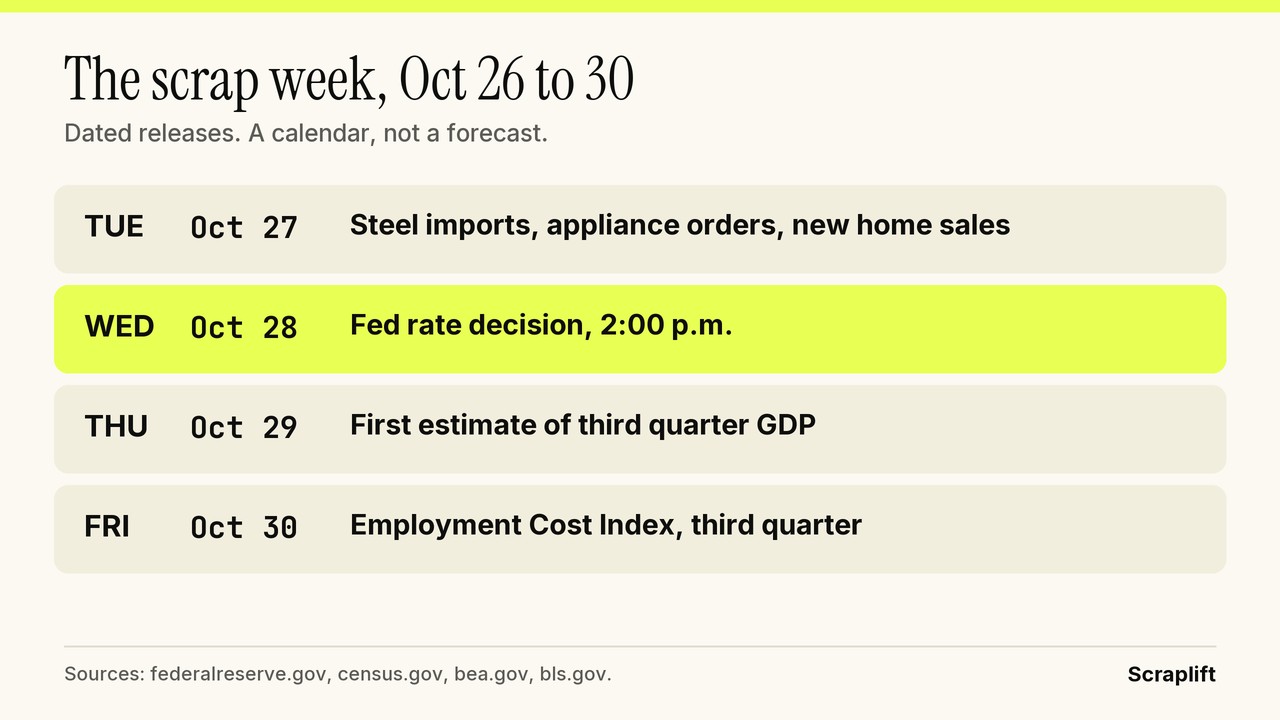
Here is the same week in words, with times in Eastern Time as each agency lists them:
- Monday, October 26: nothing on the calendars we follow.
- Tuesday, October 27: the Census Bureau's September durable goods orders at 8:30 a.m., then September new home sales and preliminary September steel imports at 10:00 a.m. The Federal Reserve's two-day meeting starts.
- Wednesday, October 28: the Fed rate decision at 2:00 p.m. and the press conference at 2:30 p.m. Earlier, the Census Bureau's advance trade, retail and wholesale numbers at 8:30 a.m.
- Thursday, October 29: the first estimate of third quarter GDP and September personal income and spending, both at 8:30 a.m.
- Friday, October 30: the Employment Cost Index for the third quarter at 8:30 a.m.
Get the app
Free.
Wednesday: the Fed rate decision

The Federal Reserve meets on October 27 and 28, per its October calendar. The Fed rate decision comes out at 2:00 p.m. on Wednesday, with the chair's press conference at 2:30 p.m.
Where the rate stands
At its last meeting, on September 16, the Fed raised its target. In its own words, the Committee "decided to raise the target range for the federal funds rate by 1/4 percentage point to 3-3/4 to 4 percent," per the September statement. The vote was 12 to 0. So the Fed rate decision this week starts from 3.75 to 4 percent, after a hike, not a cut.
We will not guess the outcome. The Fed rate decision is made by the committee on the day, and the statement is the only source that counts.
What to read in the statement
The statement is short, and three things in it matter most. First, the rate itself: up, down or unchanged. Second, the vote, since a split vote tells you the committee is not of one mind. Third, the words about what comes next. When the Fed says it will watch the data, it is keeping its options open. There is no new set of projections at this meeting, per the Fed's meeting calendar, so the statement and the press conference are all there is.
Why a hauler should care
Rates reach your scrap pile slowly, but they do reach it. Higher rates make car loans, home loans and builder loans cost more. Fewer new cars sold means fewer trade-ins scrapped later. Fewer new homes means fewer offcut bins at job sites. The Fed rate decision on Wednesday will not change your yard's board on Thursday, but it sets the weather for the work you will see this winter.
Scrap tip: Rates move slowly, so your plan should not jump every time the news does. Keep a steady list of the builders, plumbers and electricians who call you, and check in with them once a month. Steady sources ride out a slow season better than chasing one big job.
Thursday: the first read on growth
The Bureau of Economic Analysis publishes its first estimate of third quarter GDP at 8:30 a.m. on October 29, per its release schedule. September personal income and spending come out at the same time.
For a starting point, the Bureau's latest number for the second quarter is growth "at an annual rate of 2.2 percent," per its GDP page, released September 30. Thursday's number is a first estimate and gets revised twice.
Personal income and spending, out the same morning, show whether households kept buying through September. Household spending is the largest part of the economy, and it drives the appliance and car sales that turn into scrap years later.
GDP is the broad measure of everything the country makes and buys. When it slows, factories make less, and factory scrap such as offcuts and busheling slows with it. When it holds up, the flow of old equipment, appliances and cars coming out of service tends to hold up too. Read it next to the Fed rate decision from the day before, since the two together set the tone for the months ahead.
Tuesday: steel imports and November buying

The Census Bureau releases preliminary September steel imports at 10:00 a.m. on Tuesday, per its calendar. Imported steel competes with steel made in American mills, and many of those mills melt scrap. More imports can mean less mill demand for scrap, and fewer imports can mean more.
An early hint is already out. The American Iron and Steel Institute reported on October 8 that September import permits totaled 2,492,000 net tons, down 0.2 percent from August permits, with finished steel at an estimated 19 percent of the market. Permits are applications to import, not steel that arrived, which is why Tuesday's number matters.
November buying is next
On October 21, Steel Market Update reported what market participants told it: "Scrap prices will probably rise in the US in November," and "It's just a question of by how much." The November round of buying is next. That is a read on what mills pay large dealers, and it reaches a small yard's board later and only in part.
Scrap tip: When you call your yard, ask about your own grades by name, such as light iron, plate and structural, or shred. A general answer about steel may not fit your pile, and the posted price for your grade is the one that counts.
Imports and the Fed rate decision can also meet in the dollar. Interest rates are one of the things that move the dollar, and the dollar affects what imported steel costs. That is one more reason the Wednesday statement is worth reading next to Tuesday's import number.
The September import report on Tuesday is preliminary, as its name says. Read the direction, not the last ton.
Related reading: A higher steel price in the news is not always a higher scrap price for you. Steel prices up, scrap steel prices not explains how the two can move apart and what to watch instead of the headline.
Tuesday: appliance orders and new home sales

Two Census releases on Tuesday morning speak to the scrap of tomorrow.
Durable goods orders
Durable goods are things built to last, such as appliances, machinery, trucks and aircraft. The September report comes out at 8:30 a.m. For a starting point, August new orders "decreased $0.1 billion or virtually unchanged to $338.6 billion," and orders excluding transportation rose 0.3 percent, per the Census Bureau's advance report of September 25.
New washers, dryers and fridges sold today are the old ones hauled out tomorrow. When a family buys a new range, the old one usually goes to the curb or to a hauler.
New home sales

September new home sales come out at 10:00 a.m. In August, sales ran at a seasonally adjusted annual rate of 684,000, which the Census Bureau put at 6.4 percent above July, with a margin of error of plus or minus 19.5 percent, per its new home sales report of September 24. That margin is wider than the change, so the Bureau does not call the rise statistically significant.
A sold new home is a finished home, so the scrap from it already came off the job. What sales tell you is whether builders will start more. Our Monday issue from last week explained how to read starts and permits, and the Census Bureau's construction spending for September follows on Monday, November 2.
Scrap tip: New construction leaves the cleanest scrap: copper pipe ends, wire offcuts and steel studs. Ask a builder who is closing out a house if you can clear the bins, and keep copper, brass and steel in separate buckets from the start.
The rest of the week
The Bureau of Labor Statistics lists metro area jobs for September on Wednesday at 10:00 a.m. and the Employment Cost Index for the third quarter on Friday at 8:30 a.m., per its October schedule. The Energy Information Administration's weekly diesel update lands Tuesday.
For New York haulers, the Recycled Materials Association's New York Chapter holds its Fall Meeting and Networking Event on Thursday, October 29, from 6:00 to 10:00 p.m. at 230 Fifth Avenue in Manhattan, per its event page.
Related reading: Before you sell, a few minutes of notes can save an argument at the scale. Scrap tips: write it down before you sell covers what to note about each haul and why it pays off later.
What it means for this week
The Fed rate decision, GDP and the steel numbers are all slow signals. None of them changes what your yard pays on the day it comes out. Together they tell you whether the winter is likely to be busy or slow, and which kinds of scrap will be easier to find. Use them to plan your calls and your routes, and use the yard's posted board for the price.
Between issues, the scrap rates page shows posted prices by ZIP code, and Scraplift ranks the yards near you by what you clear after the drive. Last week's scrap week recap covers the October steel scrap settlement in full.
This is general market commentary, not financial advice and not a promise. Your yard's own posted price for your grade is what you are paid. Check the date and the grade on any quote before you agree to it.
Quick answers
When is the Fed rate decision this week?
The Federal Reserve meets October 27 and 28, 2026. The statement comes out Wednesday, October 28, at 2:00 p.m. Eastern, with a press conference at 2:30 p.m.
What is the federal funds rate going into the meeting?
The target range is 3.75 to 4 percent. The Fed raised it by a quarter point on September 16, 2026, by a 12 to 0 vote.
When do September steel imports come out?
The Census Bureau publishes preliminary September steel imports on Tuesday, October 27, at 10:00 a.m. Eastern.
Does the Fed rate decision change scrap prices right away?
No. Rates work slowly, through loans for cars, homes and building. Your yard's posted price for your grade is what you are paid on the day.