Scrap Week Recap: Copper Swings
Market notes · Published

Copper prices led the scrap week of October 26 to 30, 2026. The COMEX price climbed for three days and then gave back 19 cents a pound in two. This recap covers that move, the container checks in Thailand that have scrap exporters looking for other buyers, and the September factory orders. Every figure names its source and its date, and nothing here is a forecast of your yard's board.
The week in three lines
Three pieces of news mattered this week, and the card below puts them on one page.
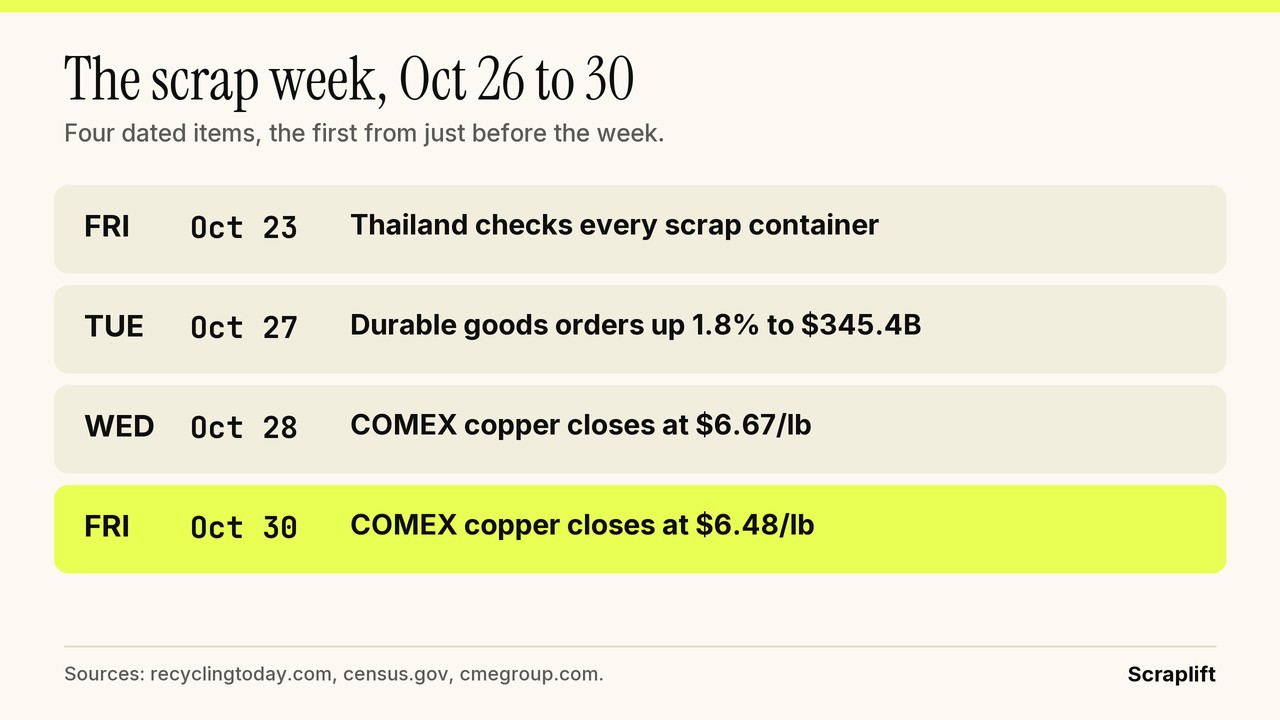
Here is the same week in words:
- Copper: the December COMEX contract settled at $6.67 a pound on Wednesday and $6.48 on Friday (CME Group, October 30).
- Thailand: customs is opening every container declared as metal scrap, and a ban on scrap imports is under consideration (Recycling Today, October 23).
- New orders: September durable goods orders rose 1.8 percent to $345.4 billion, or 0.5 percent without transportation (Census Bureau, October 27).
Get the app
Free.
Copper prices: three days up, two days down
COMEX copper is the futures price most people mean when they talk about copper prices in the United States. Here are the December contract's settlement prices for the week, per CME Group, in dollars a pound:
- Monday, October 26: $6.5420
- Tuesday, October 27: $6.6525, up 11.05 cents
- Wednesday, October 28: $6.6715, up 1.90 cents
- Thursday, October 29: $6.6025, down 6.90 cents
- Friday, October 30: $6.4820, down 12.05 cents
So the high close of the week was Wednesday, and the low close was Friday. From one to the other, copper prices fell 18.95 cents, or about 2.8 percent. Monday to Friday, the net move was only 6 cents down, so the net hides the swing.
Why we are not naming a reason
We looked for a reason from a source we trust and did not find one for the drop in copper prices on Thursday and Friday. So we are not going to guess. A price can fall for plenty of reasons, and a neat story written after the fact is often wrong. What we can tell you is what the price did, and that is enough to plan around.
What copper prices mean at your scale
A futures price is not a yard price. Your yard pays for a grade, on a given day, after its own costs, and the exchange is only one thing it watches. Think of the exchange as the weather report and your yard's board as the temperature on your own porch.
Here is a simple way to see the size of the move. Say you have 200 pounds of copper saved up. A 19 cent move is about $38 on paper, if your yard passed along all of it. A yard may pass along part of a move, later, or none of it. So treat that $38 as the top of the range, not a promise.
The swing also shows why a single headline is a poor reason to rush to the yard or to sit on a pile. Copper prices rose and fell inside one week, and a hauler who chased either move would have spent fuel on a change that may never have reached the board.
Scrap tip: Do not drive across town for a one day move in copper. Call your yard or check the posted price first, and ask for your grade by name. A two day swing on the exchange may not change what you get paid at the scale.
Keep your copper sorted
Keeping your copper sorted matters more in a choppy week, not less. Bare bright, number 2 and insulated wire are priced apart, and a mixed bucket gets the lowest grade in it. When copper prices swing, the sorted bucket is the one thing in your control.
If you plan to hold a pile for a better week, keep it locked up and keep notes on what is in it. Our post on writing it down before you sell covers what to note.
Related reading: The price on the news and the price at the scale are two different numbers. Scrap copper prices per pound walks through the yard grades and what sorts one from the next, so you know which number is yours.
Thailand checks every scrap container

This one broke just before the week, and traders were still working through it in late October. Recycling Today reported on October 23 that Thai customs "is physically inspecting every container declared as metal scrap" as it goes after illegal electronic waste. The report cites the Bangkok Post and two traders it spoke with, and it says the checks are backing up ports.
The same report says the longer-term step goes further. Thai customs is "considering classifying metal scrap and rubber scrap as prohibited imports," with a transition of six to 12 months. That is a proposal under review, not a rule in force.
Why a hauler in New York should care
Thailand matters to American scrap more than most people would guess. In the first seven months of 2026, it was the top destination for aluminum-bearing scrap shipped from the United States, per Recycling Today, citing Census Bureau numbers gathered by the U.S. Geological Survey. Thailand took 304,000 metric tons, ahead of India at 269,000, China at about 197,000 and Malaysia at 193,000.
One trader told Recycling Today the situation is "a mess," and another said sellers and buyers are working together to find other homes for containers already on the water in late October.
We do not know how much of this reaches a small yard's board, or when. The same report points out that earlier crackdowns in China and Malaysia ended with tighter but working trade routes. That is history, not a promise, but it argues against panic.
More talk of trade limits
The subject came up again on October 26 at a Bureau of International Recycling meeting in Malaga, Spain, per Recycling Today on October 27. One speaker warned that trade limits on recycled metal can mean fewer export outlets, lower scrap prices at home and weaker collection. That talk was about copper and about export limits, but the point carries over. Our reading: when scrap has fewer places to go, the pressure lands on the people who collect it.
Scrap tip: Aluminum with iron, plastic or wire left on it is harder to sell as a clean grade. Clean it where you can, keep cast apart from extrusion, and ask your yard what it wants before you bring a mixed bucket.
New factory orders rose in September

The Census Bureau's advance report on October 27 put September new orders for durable goods at $345.4 billion, up $6.3 billion or 1.8 percent. Durable goods are things built to last, such as appliances, machinery, trucks and aircraft. Orders have now risen in six of the last seven months.
Most of that gain was transportation equipment, which rose $5.2 billion to $119.8 billion. Take transportation out and new orders rose 0.5 percent, which is the steadier number to watch.
The lines closest to your work

Three lines in the same report sit closest to the scrap you handle:
- Primary metals: new orders up 0.5 percent to about $33.0 billion. This is mills and foundries.
- Fabricated metal products: up 0.4 percent to about $45.2 billion. Shops that cut and shape metal also throw off clean offcuts.
- Machinery: up 1.2 percent to about $46.0 billion.
One line went the other way. Electrical equipment, appliances and components slipped 0.3 percent to about $18.9 billion. That is the line closest to the washers and dryers you pick up, though a new appliance ordered this month is a scrap appliance years from now.
There is one more thing to keep in mind. These numbers are in dollars and are not adjusted for price changes, so higher prices can lift orders with no more goods behind them. Read it as a sign that factories stayed busy, and leave it at that.
Busy factories matter to a small hauler in a plain way. Shops that are cutting and stamping metal make offcuts, and offcuts need to go somewhere.
Scrap tip: Machine shops and small fabricators often have a bin of clean offcuts and no time to deal with it. Stop in on a slow morning, leave your number, and offer a regular pickup. A steady shop beats chasing one big cleanout.
What we watch next week
Here is what is on the calendars for November 2 to 6, with times in Eastern Time as each agency lists them:
- Monday, November 2: construction spending at 10:00 a.m., per the Census Bureau's calendar.
- Tuesday, November 3: the full factory orders report at 10:00 a.m., which fills in this week's advance numbers.
- Wednesday, November 4: trade in goods and services for September at 8:30 a.m. This is the Census Bureau trade data where scrap exports are counted, so it is one to read with Thailand in mind.
- Friday, November 6: the jobs report for October at 8:30 a.m., per the Bureau of Labor Statistics schedule.
We will also watch copper prices and the November round of steel scrap buying, which Steel Market Update said on October 26 was expected to bring higher prices. The Central Atlantic diesel average was $6.496 a gallon for the week of October 26, per the Energy Information Administration.
Related reading: Slow signals work best next to the numbers that came before them. Our scrap week ahead for October 26 to 30 laid out this week's calendar and explained how to read the Federal Reserve and the factory numbers as a hauler.
What it means for this week
Copper prices moved, and they may move again. Thailand is a real problem for exporters and a question mark for everyone else. Factory orders say the shops are still working. None of it is a number to quote at the scale. Use it to decide who to call and what to keep sorted, and use the posted board for the price.
Between issues, the scrap rates page shows posted prices by ZIP code, and Scraplift ranks the yards near you by what you clear after the drive. Last week's scrap week recap covers the October mill buying in full.
This is general market commentary, not financial advice and not a promise. Your yard's own posted price for your grade is what you are paid. Check the date and the grade on any quote before you agree to it.
Quick answers
What happened to copper prices the week of October 26?
The December COMEX contract rose to $6.67 a pound on Wednesday, then fell to $6.48 on Friday, per CME Group. That is a drop of about 19 cents in two days.
Is the COMEX copper price what a yard pays?
No. COMEX is a futures price. Your yard pays for a grade on a given day, after its own costs, and that price is the one on its board.
Why is Thailand inspecting scrap containers?
Thai customs is looking for illegal electronic waste in containers declared as metal scrap, per Recycling Today. A ban on scrap imports is under consideration, with a transition of six to 12 months.
What did durable goods orders do in September?
They rose. The Census Bureau's advance report put new orders up 1.8 percent to $345.4 billion. Without transportation, they rose 0.5 percent.